

In the last post I showed you how to switch off data sharing for training in many AI models. But why does that matter so much in the first place?
The answer has less to do with the technology than with us humans – or more precisely, with our children.
“Mum, I just quickly used AI to improve my class test.”
A harmless sentence. But the photo of that class test may well show the child’s name, the school, the teacher’s comments or other personal information. To a child, this often feels completely normal. They’re simply showing the AI something they need help with.
And that’s exactly where the challenge lies.
Children often don’t see AI as a stranger
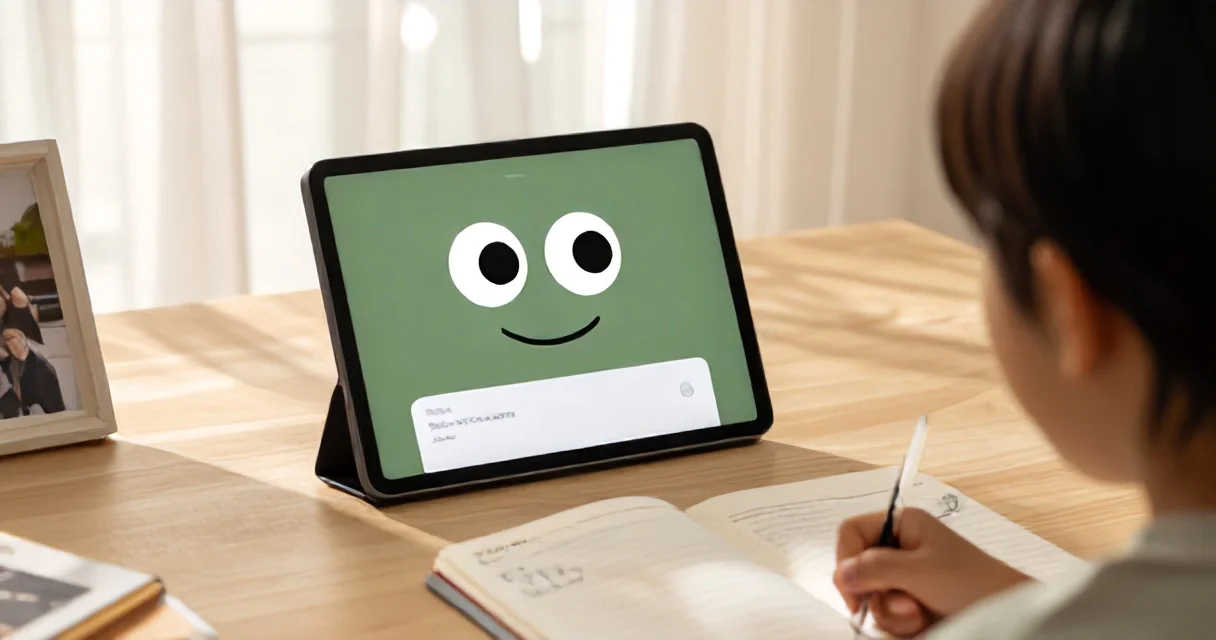
When adults use a chatbot, they usually know they’re communicating with a computer program. Children often experience it differently.
Modern AI systems answer in a friendly, patient and understanding way. They explain things, praise good ideas and often come across like a conversation partner. That quickly creates the feeling of talking to someone who’s listening and wants to help.
Studies show that many children treat chatbots much like friends or confidants. They tell them things they would never tell a stranger.
The problem isn’t that children are careless. The problem is that they often can’t yet judge the consequences.
The real problem with free AI
Many free AI models learn from the chats you type in by default. Depending on the provider, content, questions, files, images or conversations may be used to improve the models.
That’s why data protection and security experts recommend switching off the use of your own data for AI training wherever possible.
But even with that setting turned off, one important principle still holds:
Private information should never be entered into an AI unfiltered.
Because children often give away considerably more than they realise. And honestly, that happens to plenty of adults too.
How personal data gets passed on without anyone noticing
Most children don’t deliberately type their address or phone number into an AI chat.
Far more often, it happens indirectly.
A photo of a class test often contains names, school names or handwritten notes. An uploaded letter from a doctor reveals health data. A school report contains personal information. Even an account of an argument with teachers, problems with classmates or difficulties within the family can contain sensitive data.
And this problem is by no means new.
Long before ChatGPT existed, people were sharing personal information online without being aware of it. On Facebook or Instagram, photos were posted in front of people’s own homes with street signs, house numbers or even the name on the letterbox visible. Families published holiday photos, first-day-of-school pictures or their children’s school reports without noticing how much information those actually contained.
Most people don’t do this out of carelessness. They simply don’t think about what other details are still visible in a photo or a document.
Exactly the same thing is happening today with AI.
The only difference is that a chat window is now used instead of a social media post. The underlying problem stays the same: people often reveal more information than they realise.
Once information like that has been passed on without thinking, you quickly lose track of which personal details you’ve already given away.
Why parents should take this seriously
Free AI is not a private diary.
Many services store chats in the cloud. Some providers use content to improve their models. At the same time, research shows that under certain conditions training data could be partially reconstructed.
For most families, that doesn’t mean personal information will suddenly become public. Even so, the same principle applies as with social media:
Once something has been uploaded, you should treat it as permanently shared.
That’s exactly why it’s better to be safe than sorry.
The real danger isn’t the AI
There’s often debate about whether AI is dangerous, when the greater risk frequently lies elsewhere. The real challenge comes from the combination of curious children, powerful free tools and a lack of knowledge about safety.
Children want to solve problems, and AI can help them do that very quickly. But nobody explains to them which information should stay private. That’s precisely why children need guidance.
The good news
You can still use AI sensibly and safely, because in most cases it’s already enough to neutralise personal information.
Instead of a real name, for example, you can write “my child”. Instead of a complete letter from a doctor, just the relevant text will do, and instead of an entire official document, the relevant section without personal data is enough. You can fold paper so that data isn’t visible, and in the middle of a text, names or other personal details can simply be blacked out or covered up.
That way you keep the AI’s help while protecting sensitive information.
Our safety checklist for families
That’s exactly why we developed the Famalyzer safety checklist.
It helps families see at a glance which information can be entered without concern and which should never go into an AI chat.
Among other things, you’ll find:
- clear “never enter this” categories
- a simple traffic-light system for AI use
- safe alternative wordings
- examples covering family, school and health data
- practical short checklists for parents
Children don’t need an AI-free world
Many parents wonder whether their children should be using AI at all. The better question is:
How can children learn to use AI safely?
Because AI isn’t going away. It will play an ever greater role in school, training and work.
So children don’t need an AI-free world – they need adults who show them how to use AI wisely, critically and safely.
Because the biggest danger usually isn’t the technology itself, but the lack of experience in handling it.
If you teach your children which information should stay private, they can enjoy the benefits of AI without taking unnecessary risks.
Free safety checklist for parents
Want to know which data should never go into an AI chat?
Then get the free Famalyzer AI safety checklist.
In just a few minutes, it will help you see:
- which data can be entered without concern
- which data should be anonymised
- which information should never go into an AI
- how to better protect school, family and health data
If you’d like to receive the checklist free of charge, just use the contact form and write the word “Sicherheit” in the message field.
We’ll then send you the checklist by email, free of charge.
If you haven’t read the previous post yet, you’ll also find a guide there on how to switch off the use of your data for training in many AI models. Even though that’s no cast-iron guarantee, it’s a sensible first step towards better data protection.